When Calming Supplements for Dogs Don't Work (And What They're Actually For)

Table of Contents
- Do calming supplements for dogs work?
- Think of calming supplements as support, not treatment
- What is Cani Calm actually designed to do?
- What Cani Calm is NOT
- So when should you NOT use a calming supplement for dogs?
- 1. Your dog has a training problem
- 2. You’re dealing with reactivity
- 3. Your dog is aggressive
- 4. Your dog’s behaviour has suddenly changed
- 5. Your dog has genuine separation-related distress
- 6. Your dog has a severe fear or phobia
- 7. Your dog’s problem is actually boredom
- 8. You want your dog’s personality removed
- 9. You’re expecting an instant visible transformation
- The “clearer mind for training” idea
- Calming supplements shouldn’t replace proper dog training
- But what if anxiety is so high that training isn’t working?
- So when IS Cani Calm appropriate?
- How long should you give a dog calming supplement?
- Why doesn’t Cani Calm sedate dogs?
- Are natural calming supplements better than anxiety medication?
- How do I know if my dog needs a trainer, behaviourist or vet?
- Frequently Asked Questions
- The bottom line: stop expecting supplements to train your dog
Let’s get something out of the way straight away.
A calming supplement will not fix your dog’s behaviour.
There. We said it.
And considering we make and sell a calming supplement for dogs, that’s probably not the opening you were expecting.
But it’s important.
Because one of the biggest misconceptions around calming supplements for dogs is that you give your dog a scoop, chew or tablet and suddenly:
- they stop barking at other dogs
- they’re happy being left alone
- they stop pulling on the lead
- their recall improves
- they stop guarding food
- fireworks no longer bother them
- they become perfectly behaved little angels
That’s not how they work.
It’s certainly not how Cani Calm is designed to work.
Cani Calm is designed to provide nutritional support for things involved in relaxation, mood, focus and the nervous system.
The aim is to support your dog’s baseline.
And for some dogs, bringing that baseline down a notch may give you a calmer, clearer dog who is in a better place to learn.
But you still have to do the learning.
A calming supplement can support the dog you’re training. It cannot do the training for you.
That distinction matters enormously.
So, let’s talk about what calming supplements actually do, when they’re worth considering and, perhaps more importantly, when a calming supplement is absolutely not the answer to your dog’s problem.
Do calming supplements for dogs work?
Yes.
No.
Sometimes.
Helpful article, wasn’t it?
The problem is that “do dog calming supplements work?” is actually a much bigger question than it sounds.
There isn’t one ingredient called calming supplement.
Different products contain completely different combinations of:
- amino acids
- botanicals
- vitamins
- minerals
- peptides
- pheromones
- nutritional compounds
They use different quantities.
They’re given for different lengths of time.
And they’re being given to dogs experiencing completely different things.
A Labrador who’s slightly overstimulated when visitors arrive is not the same as a rescue dog experiencing severe separation-related distress.
A dog who’s a little unsettled during a car journey is not the same as a dog with a genuine noise phobia.
And a dog struggling to concentrate during training is definitely not the same as a dog displaying aggression towards people.
Putting all of those into one bucket and asking whether a “calming supplement works” isn’t particularly useful.
The evidence is also more nuanced than the marketing would have you believe
Take L-tryptophan, for example.
It’s an essential amino acid and a precursor involved in serotonin production, which is why you’ll find it in a number of calming diets and supplements, including Cani Calm.
But that doesn’t mean giving a dog tryptophan automatically transforms their behaviour.
A 2024 review examining supplementary tryptophan for anxiety in adult dogs found mixed results.
One controlled study found no significant overall effect on anxiety-related behaviour, while another reported improvements in owner-assessed anxiety when tryptophan was included alongside another ingredient.
The review’s conclusion was particularly important:
Tryptophan supplementation alone is not enough to act as a sole treatment for anxiety in anxious dogs.
And we completely agree.
That’s pretty much the point of this entire article.
Think of calming supplements as support, not treatment
We humans take supplements all the time.
And I think this is where expectations get muddled.
Let’s use something simple like a vitamin supplement.
If somebody has been advised to supplement vitamin B12 because their intake or levels need supporting, do they swallow the tablet and 20 minutes later sit there thinking:
“Bloody hell. I can really feel that B12 kicking in.”
Probably not.
That doesn’t mean the nutrient suddenly has no biological function.
We seem perfectly capable of understanding that distinction when it comes to ourselves.
But with our dogs, we often expect something completely different.
We give them a calming supplement on Tuesday.
Wednesday morning arrives.
Dog still barks at the postman.
“Didn’t work.”
But barking at the postman is a behaviour.
What did we expect the supplement to do?
Erase the dog’s memory of the postman? Teach him that Dave from Royal Mail isn’t actually invading the house?
Of course not.
Caffeine is almost the opposite example
Drink a strong coffee and you’ll probably notice something.
You may feel more awake, more alert or more focused.
But caffeine still doesn’t do anything for you.
It doesn’t write the report you’ve been avoiding.
It doesn’t make you productive.
It doesn’t fix the fact you stayed up until 1am watching videos.
It changes part of your physiological state.
You then decide what to do with that state.
That’s much closer to how I think we should view calming supplements.
The goal isn’t necessarily:
“My dog’s behaviour visibly changes after one scoop.”
It’s:
“Can I give my dog nutritional support that helps put them in a better state from which we can work?”
That is a completely different expectation.
What is Cani Calm actually designed to do?
Cani Calm is our daily calming supplement for dogs, formulated with amino acids, botanicals and nutritional ingredients selected to support relaxation, mood, focus and normal nervous-system function.
It currently contains:
Lemon Balm (180mg per scoop)
Melissa officinalis, better known as lemon balm, is a botanical traditionally associated with relaxation and nervous-system support. We’ve written more about the history and use of this ingredient, alongside passion flower, in our lemon balm and passion flower for dogs guide.
L-Tyrosine (80mg per scoop)
Tyrosine is an amino acid used by the body as a precursor in the production of neurotransmitters including dopamine and noradrenaline.
That’s one reason we’ve included it alongside ingredients aimed at relaxation.
Because our intention isn’t to make your dog sleepy.
We want to support composure and focus too.
L-Tryptophan (70mg per scoop)
Tryptophan is an essential amino acid involved in serotonin synthesis.
As we’ve already discussed, the evidence around supplemental tryptophan and canine anxiety isn’t magically conclusive.
Some research has reported improvements in anxiety-related behaviours while other studies haven’t found a significant effect.
That nuance matters.
We’re not hiding it.
Passion Flower (50mg per scoop)
Passion flower is another botanical traditionally used for relaxation and is included as part of Cani Calm’s wider formulation rather than treated as some standalone miracle ingredient.
Taurine (30mg per scoop)
Taurine is involved in numerous physiological processes and has roles within the nervous system as well as cardiovascular function.
Brewer’s Yeast
Our base also provides naturally occurring B vitamins, which have various functions within normal energy metabolism and nervous-system health.
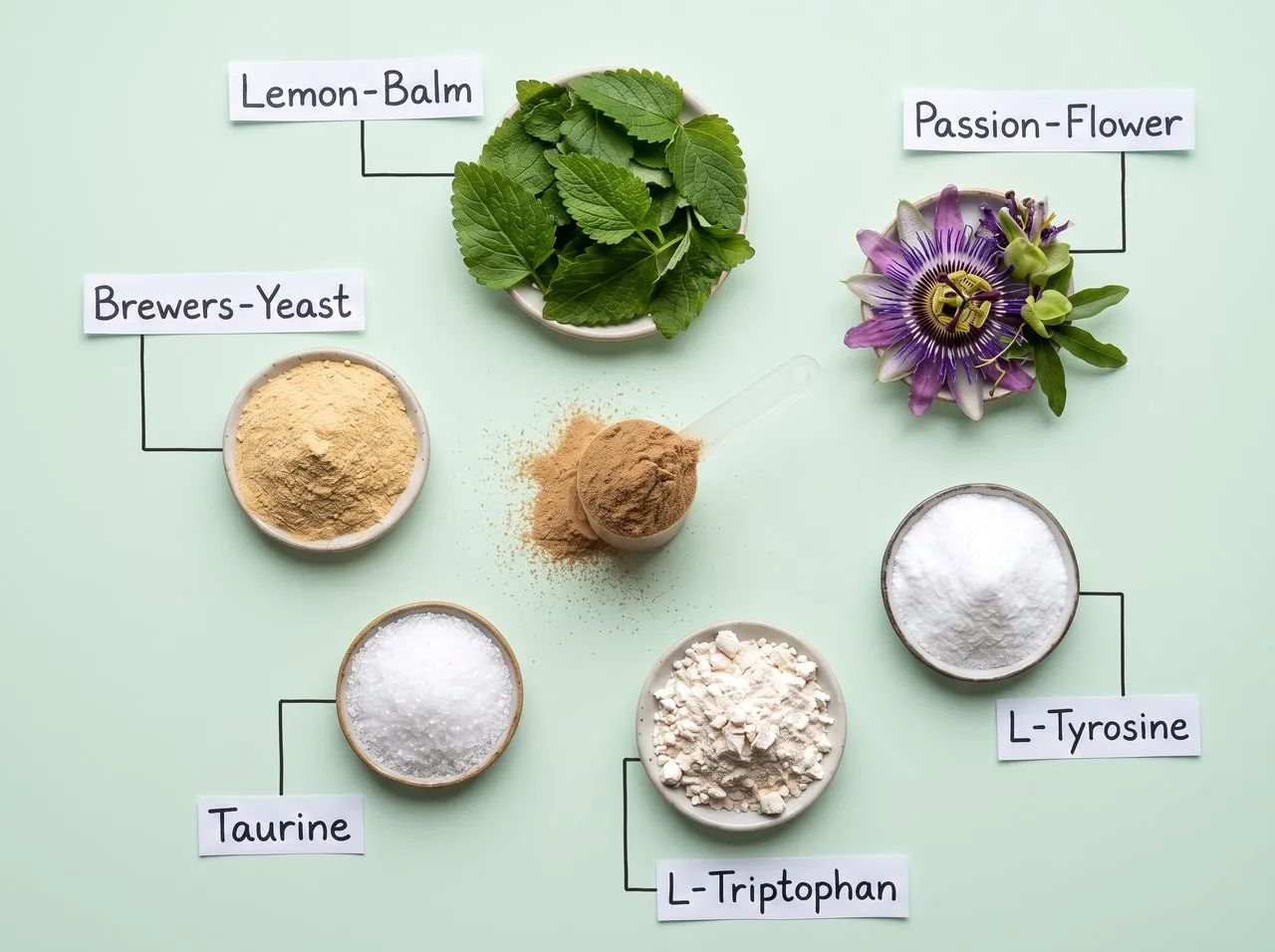
You can see the full ingredient panel and feeding guide on the Cani Calm product page.
And that’s the key:
Cani Calm is a blend.
We’re not claiming one ingredient presses a button in your dog’s brain marked CALM.
We’re providing several nutritional ingredients with relevant biological functions as part of a daily formula.
What Cani Calm is NOT
Just as important as explaining what something does is explaining what it doesn’t do.
So here goes.
Cani Calm is not a sedative.
Cani Calm is not behavioural therapy.
Cani Calm is not a replacement for training.
Cani Calm is not a veterinary anxiety medication.
Cani Calm will not cure separation anxiety.
Cani Calm will not cure reactivity.
Cani Calm will not stop aggression.
Cani Calm will not fix poor socialisation.
Cani Calm cannot teach your dog how you’d like them to behave.
If somebody is selling you a nutritional supplement and promising all of those things, we’re going to politely stand over here.
So when should you NOT use a calming supplement for dogs?
This is where things get more important.
There are situations where trying a calming supplement isn’t necessarily wrong, but using one as your solution absolutely is.
1. Your dog has a training problem
Let’s take a common example.
Your dog sees another dog.
They pull towards them.
They bark.
They completely stop listening to you.
You buy a calming supplement.
Two weeks later, your dog still reacts to dogs.
Did the supplement fail?
Not necessarily.
Because where in that process did your dog learn a different behaviour?
If the reaction has been repeated for months or years, it’s now part of a learned behavioural pattern.
Your dog may need help learning things such as:
- disengagement
- checking back in with you
- creating distance
- alternative behaviours
- emotional regulation around the trigger
A supplement can’t teach those things.
What it may be able to do is support a calmer baseline so that your dog is more receptive to training.
And that’s where Cani Calm makes much more sense to us.
Supplement + appropriate training.
Not:
Supplement instead of training.
2. You’re dealing with reactivity
Reactivity is another enormous one.
A reactive dog isn’t simply a dog with an empty Cani Calm scoop somewhere inside them.
Dogs can become reactive for lots of reasons.
Fear.
Frustration.
Over-arousal.
Previous experiences.
Pain.
Poor socialisation.
Learned behaviour.
Sometimes a combination of several.
If your dog reacts strongly to other dogs, people, bikes, cars or anything else in their environment, you need to understand why the behaviour is happening.
Otherwise you’re trying to solve the symptom without identifying the cause.
A calming supplement might form part of your wider strategy.
But if you continue putting the dog into situations where they repeatedly go over threshold, the fact you’re sprinkling something onto breakfast isn’t going to magically undo that.
3. Your dog is aggressive
This one deserves zero ambiguity.
If your dog is displaying aggression towards people or other animals, do not rely on a calming supplement to deal with it.
Aggression can have many underlying causes, including:
- fear
- pain
- resource guarding
- frustration
- territorial behaviour
- learned behaviour
- medical problems
It can also present a genuine safety risk.
Your first step should be speaking to an appropriately qualified veterinary professional and, where appropriate, a properly qualified canine behaviour professional.
Veterinarians also have an important role in behavioural cases because physical health problems, including pain, can contribute to behavioural changes. AVSAB’s own guidance on pain and aggression specifically highlights veterinary assessment as part of behavioural care for this reason.
Cani Calm can support relaxation.
It cannot diagnose or treat aggression.
4. Your dog’s behaviour has suddenly changed
This is another situation where reaching straight for a tub of calming powder isn’t appropriate.
Imagine your normally relaxed dog suddenly:
- doesn’t want to be touched
- growls when approached
- struggles to settle
- becomes unusually clingy
- starts snapping
- stops wanting to go for walks
- becomes restless overnight
Don’t automatically assume:
“They’ve become anxious.”
Behaviour changes can sometimes be associated with pain or underlying illness.
Dogs aren’t particularly good at sending us a formal email saying:
“Morning. Just FYI, my lower back has been hurting for approximately three days.”
Behaviour is often communication.
A sudden significant behavioural change should therefore justify a conversation with your vet.
Rule out the dog before trying to fix the behaviour.
5. Your dog has genuine separation-related distress
This is another area where the word anxiety gets thrown around very casually.
There’s a huge difference between:
“My dog has a little trouble settling when I leave.”
and:
“My dog enters a state of panic when left alone.”
Dogs experiencing severe separation-related distress may:
- vocalise continuously
- pant or drool excessively
- pace
- destroy doors or windows
- attempt to escape
- toilet indoors despite normally being house-trained
- refuse food
- injure themselves
That’s not a dog being naughty.
And it isn’t something you should expect a nutritional supplement to fix.
Separation-related problems often require a structured behaviour programme and, in more serious cases, veterinary involvement.
Could nutritional calming support form one small part of the overall approach?
Potentially.
But Cani Calm should not be positioned as a treatment for clinical separation anxiety.
6. Your dog has a severe fear or phobia
Fireworks are the obvious example.
Some dogs become a little unsettled.
Others become genuinely terrified.
Those are not equivalent.
For a mildly nervous dog, things such as:
- preparing a safe space
- closing curtains
- using background noise
- staying calm
- providing enrichment
- starting appropriate calming support beforehand
may all form part of sensible management.
But a dog that is shaking uncontrollably, desperately trying to escape or experiencing extreme distress needs more support.
The BSAVA recommends behavioural management and environmental modifications for noise fear, alongside evidence-based medication where appropriate. Longer-term treatment can include desensitisation and counterconditioning.
Notice what isn’t recommended?
Buy a supplement and hope for the best.
For significant noise phobias, talk to your vet well before fireworks season begins.
7. Your dog’s problem is actually boredom
I love this one.
“My dog is completely mental in the evening. What calming supplement should I use?”
Possibly none.
First question:
What has your dog actually done today?
Dogs need appropriate opportunities for:
- exercise
- sniffing
- exploration
- play
- chewing
- social interaction
- training
- mental stimulation
- sleep
A young working breed that’s been inside all day isn’t necessarily suffering from a nutritional calming deficiency.
They might just need something to do.
Likewise, a dog that’s chronically overtired can become difficult to settle too.
You need to look at the whole dog.
No supplement compensates for an unsuitable daily routine.
8. You want your dog’s personality removed
This might sound ridiculous.
But it’s surprisingly common.
Some dogs are energetic.
Some dogs are excitable.
Some dogs are naturally more alert.
Some dogs love absolutely everybody they encounter and behave as though Auntie Janet arriving for Sunday lunch is the greatest event in recorded history.
That’s your dog.
A calming supplement shouldn’t turn an enthusiastic young Spaniel into a decorative cushion.
And we wouldn’t want Cani Calm to.
The goal is not sedation.
The goal is supporting calmness and focus while your dog remains themselves.
9. You’re expecting an instant visible transformation
This is probably the biggest problem with calming supplements.
People expect something they can see.
If we gave you a veterinary sedative, you’d obviously see a physical effect.
But Cani Calm isn’t a sedative.
And that’s deliberate.
So the effect you’re looking for may be much more subtle.
Perhaps your dog:
- settles slightly quicker
- redirects back towards you sooner
- appears less easily overwhelmed
- stays engaged with training for longer
- has a little less edge during normally stressful situations
- finds switching off easier
And sometimes you might notice very little.
Dogs are individuals.
There is no nutritional supplement on Earth that works identically in every animal.
That’s why we offer our 60-day money-back guarantee.
We’d rather you actually try Cani Calm consistently and decide whether it’s useful for your dog than claim it’s guaranteed to transform every dog that eats it.
The “clearer mind for training” idea
This is probably the easiest way to explain how we think about Cani Calm.
Imagine you’re trying to teach someone something while they’re extremely stressed.
You can keep repeating yourself.
You can make the instructions louder.
You can wave a biscuit around.
But if their brain is busy screaming:
DANGER DANGER DANGER DANGER
learning isn’t going particularly well.
Dogs aren’t any different in that respect.
Once a dog becomes highly aroused or frightened, maintaining attention and learning becomes more difficult.
So instead of imagining a calming supplement as something that changes behaviour, imagine it as one of several tools designed to help create a better environment for behaviour change to happen.
That’s our philosophy behind Cani Calm.
Cani Calm supports the baseline.
Training teaches the behaviour.
Management prevents repeated problems.
A behaviourist helps you understand more complex behavioural issues.
A vet investigates medical causes and clinical anxiety.
Those things can work together.
They shouldn’t be confused with one another.
Calming supplements shouldn’t replace proper dog training
And when we say training, we don’t mean dominating your dog into submission either.
Modern veterinary behavioural guidance supports reward-based training.
The BSAVA recommends positive reinforcement methods and advises against aversive techniques such as shouting, physical corrections, lead jerking, shock collars and similar punishment-based approaches because of their potential welfare consequences.
The Royal Veterinary College has similarly highlighted associations between aversive training methods and problem behaviours, while recommending reward-based alternatives.
So if your dog is struggling, don’t just calm them.
Teach them.
Help them understand what you’d like them to do instead.
But what if anxiety is so high that training isn’t working?
Then we’re into another important distinction.
Sometimes a dog is so anxious that simply trying harder with training isn’t appropriate either.
Veterinary behavioural medicine exists for a reason.
Prescription anxiety medication can be enormously useful for some dogs and should not automatically be viewed as some terrifying last resort.
Even the American Veterinary Society of Animal Behavior notes that pharmaceuticals shouldn’t automatically be reserved until everything else has failed in behavioural cases.
And medication doesn’t replace behavioural work either.
It’s the same basic principle.
Change the state enough to make the learning possible.
Sometimes nutritional support is sufficient.
Sometimes environmental changes make the biggest difference.
Sometimes structured behavioural work is required.
Sometimes veterinary medication is appropriate.
Sometimes it’s all of the above.
The individual dog determines the answer, not whatever product is currently being advertised to you on Instagram.
So when IS Cani Calm appropriate?
Now that we’ve spent most of an article explaining when not to buy our product, we should probably cover that.
Cani Calm makes the most sense when you’re looking for daily nutritional support for calmness, focus and emotional balance.
For example:
A dog who becomes easily overstimulated
You still work on settling and impulse control, but Cani Calm can sit alongside that training.
A dog who is mildly nervous in unfamiliar environments
You’re still creating positive experiences and avoiding overwhelming them.
The supplement is support.
A dog you’re actively training through mild anxious behaviour
This is probably the perfect example.
You’re doing the behavioural work already and want nutritional support alongside it.
A dog who struggles to switch off
Assuming you’ve already considered exercise, enrichment, sleep and routine.
Predictable stressful periods
Travel, changes in routine, visitors, moving house or noisy periods may all increase stress in some dogs.
Again, management still matters.
As part of a wider behaviour plan
There’s absolutely no reason nutritional calming support and professional behavioural work have to be an either/or choice.
In fact, that’s exactly how we’d prefer Cani Calm to be used.
How long should you give a dog calming supplement?
This depends enormously on the formulation.
Cani Calm is formulated for daily use, rather than being something we expect you to throw at your dog five minutes before the doorbell rings.
Consistency also gives you a much better opportunity to judge whether it’s actually making a difference.
If you’re assessing Cani Calm, don’t just ask:
“Is my dog’s problem gone?”
Ask:
- Are they settling more easily?
- Are they recovering faster?
- Are they easier to engage?
- Is training becoming easier?
- Are stressful events slightly more manageable?
- Are they better able to focus?
Those are much more useful questions.
Because remember, we’re supporting the baseline, not deleting the behaviour.
Why doesn’t Cani Calm sedate dogs?
Because sedation isn’t our goal.
We deliberately use a combination designed around relaxation AND focus.
If you’ve got a dog you’re actively trying to train, making them half asleep isn’t particularly helpful.
We want a dog who can think, engage, learn, settle, and still very much be your dog.
That’s why Cani Calm isn’t intended to produce the sort of dramatic visible reaction people sometimes associate with a “working” calming product.
The absence of sedation isn’t evidence that nothing is happening.
It’s part of the point.
Are natural calming supplements better than anxiety medication?
This shouldn’t be a competition.
And we’re quite strongly against marketing natural calming supplements as though they’re the virtuous alternative to veterinary medication.
There are situations where nutritional support makes sense.
And there are situations where your vet may believe medication is the most appropriate thing for your dog’s welfare.
One doesn’t invalidate the other.
If your dog’s anxiety is significantly affecting their quality of life, speak to your vet.
Don’t avoid appropriate treatment because somebody on Facebook told you pharmaceuticals are bad.
Likewise, don’t jump immediately to trying to medicate a normal young dog who actually needs training and appropriate enrichment.
Context matters.
How do I know if my dog needs a trainer, behaviourist or vet?
As a rough guide:
Trainer
Useful for teaching skills, improving communication and working through many everyday training problems.
Behaviour professional
Appropriate when behaviour has a stronger emotional component: fear, reactivity, guarding, anxiety and more complex behavioural patterns.
Qualifications matter here, so check the credentials of whoever you’re trusting with your dog.
Vet
Your vet should be involved where there has been a sudden behavioural change, suspected pain or illness, severe anxiety, self-injury, significant aggression or when veterinary behavioural medication may be required.
Very often these professionals work together.
That’s a good thing.
Frequently Asked Questions
Do calming supplements for dogs actually work?
Some calming ingredients have evidence suggesting potential effects on stress or anxiety-related behaviour, but results vary considerably between ingredients, formulations and individual dogs.
For example, research into L-tryptophan has produced mixed results, with a 2024 evidence review concluding it should not be relied upon as a sole treatment for anxiety.
A calming supplement is best viewed as support, rather than a cure for behavioural problems.
What is the best calming supplement for dogs?
There isn’t one universally “best” calming supplement.
Look at the actual ingredients, quantities, intended use, manufacturer transparency and evidence rather than simply looking for whichever product makes the biggest claim.
For more serious anxiety or behavioural problems, speak to your vet or an appropriately qualified behaviour professional.
Can calming supplements stop my dog barking?
Not directly.
Barking is a behaviour and can have many causes, including excitement, fear, frustration, alerting, boredom or learned behaviour.
Supporting calmness may make training easier in some dogs, but you’ll still need to address why the dog is barking and teach appropriate alternative behaviours.
Will calming supplements stop dog reactivity?
A supplement cannot teach a reactive dog a new response to its triggers.
It may form part of a broader behaviour plan by supporting a calmer baseline, but reactivity normally requires appropriate management and behaviour modification.
Can calming supplements help with dog anxiety?
Potentially, depending on the dog, severity of the anxiety and product being used.
Mild nervousness and clinical anxiety are not the same thing.
Dogs experiencing significant or persistent anxiety should be assessed by a veterinary professional.
Will Cani Calm make my dog sleepy?
Cani Calm is designed to be non-sedating.
Our aim is to support relaxation while maintaining focus and normal activity rather than making dogs drowsy.
Can Cani Calm fix behavioural problems?
No, and we want to be completely clear about that.
Cani Calm is designed to support your dog’s baseline calmness, focus and emotional balance.
It does not replace training, behavioural modification or veterinary treatment.
Can I use Cani Calm while training my dog?
That’s actually one of the situations where we think Cani Calm makes the most sense.
If you’re already working on behaviour and training, supporting a calmer, more focused baseline may help create better conditions for learning.
Think: Cani Calm supports the dog. Training teaches the dog.
The bottom line: stop expecting supplements to train your dog
We make Cani Calm.
We’re incredibly proud of it.
We spent a lot of time deciding what went into it and, just as importantly, what we wanted it to be.
But we’re never going to tell you that one scoop of powder is going to cure your dog’s behaviour.
Because it won’t.
If your dog needs training, train them.
If your dog is bored, meet their needs.
If your dog has significant behavioural problems, get appropriate professional help.
If your dog’s behaviour has suddenly changed, speak to your vet.
And if your dog would benefit from nutritional support for their everyday baseline of relaxation, focus and emotional balance, that’s where Cani Calm comes in.
It’s one part of the picture.
Not the whole picture.
And personally, we think being honest about that makes for a much better calming supplement.